
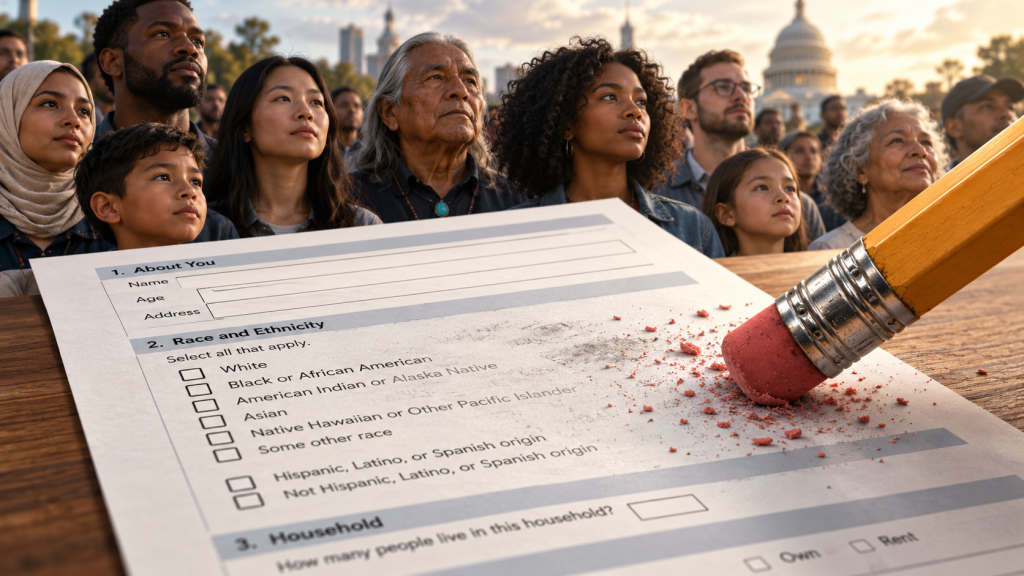
On September 10, the Trump administration proposed adding two new parts to the Code of Federal Regulations governing the decennial collection of census data. First, it wants to eliminate questions about race, ethnicity, and sexual orientation from the questionnaires, arguing that these questions are unnecessary for determining population totals and that removing them would reduce reporting burdens, protect privacy, and improve participation. Secondly, it proposes revising residency reporting to exclude certain noncitizens, including undocumented immigrants, from the population count used to determine each state’s representation in Congress. The public comment period closes on November 2.
The administration argues the proposed new rule would count people, not classify them, and that the census should be colorblind. It argues that race isn’t necessary to determine how many people live in each state, so removing racial questions helps focus on its core mission: counting people. It says the government should move towards treating Americans as individuals rather than members of designated racial blocs and that increasing multiracial options can make classifying identity overly complex.
According to the Pew Research Center, nearly half (46%) of Americans, including 54% of Asians, 48% of White, 45% of Black, and 40% of Latino adults, say the government should collect data on race. More Black (37%) and Latino (37%) adults favor eliminating race questions than White (30%) and Asian (27%) adults. More Republicans and those leaning Republican (52%) say the government should collect race data than Democrats and independent-leaning Democrats (43%). Among those opposed to collecting race data, Black adults (18%) are more likely to cite potential bias and discrimination than White adults (7%).
Although the Trump administration would like the federal government to treat all Americans the same regardless of race, we are still many years from race not being a factor in the United States. The Census Bureau says it uses racial data to enforce civil rights, and KFF (formerly the Kaiser Family Foundation) warns that changes to racial data collection could hamper efforts to address health disparities. The administration claims it could obtain racial data from other sources, such as the American Community Survey (ACS), administrative records, health statistics, and specialized research. Unlike U.S. Census data, ACS uses sampling methods with a margin of error.
Social workers must consider whether civil rights can be enforced without comprehensive racial and ethnic data, and how to track disparities in housing, poverty, child welfare, healthcare access, and economic well-being without reliable data. How reliable are the American Community Survey data?
The proposed revisions also include residency criteria needed to determine who counts toward the population used for congressional apportionment and federal funding. Excluding certain noncitizens, such as undocumented immigrants and refugees, could leave states shorthanded when providing services for all their residents, many of whom pay taxes and contribute to the economy in many ways.
The administration’s proposed changes raise several significant constitutional questions, including who counts for political representation. Article 1, Section 2 of the Constitution calls for enumerating the whole number of free persons, excluding Indians not taxed, and three-fifths of all other persons, which could be confusing. Section 2 of the 14th Amendment reiterates that each state counts the whole number of persons. The critical word is persons, not citizens. The Trump administration argues that undocumented immigrants are not qualified persons living in states.
The 14th Amendment also guarantees equal protection under the law. In its recent Louisiana v. Callais decision, which ruled against creating a second majority-Black congressional district, the Court upheld the need to comply with Section 2 of the Voting Rights Act, which supports the need to collect racial data. The 15th Amendment prohibits denying or abridging the right to vote because of race or ethnicity. Census data are needed to demonstrate compliance.
While the public is divided over the need to collect racial census data, one should view these proposals with skepticism given the Trump administration’s assault on diversity, equity, and inclusion (DEI) policies and its draconian deportation methods. Without comprehensive racial data, it’s more difficult to document whether racial disparities are improving, worsening, or remaining the same. There are those, particularly on the right, who would like us to believe we achieved a colorblind society with President Obama’s election. While that was certainly a major milestone, evidence such as health and wealth disparities shows we still have a way to go.
If racial discrimination continues to exist, whose interests are served when government becomes less capable of measuring it? For social workers, the essential issue is not whether government should classify people indefinitely by race. It is whether government can fulfill its obligations to equality, accountability, and fair representation without reliable evidence of the inequalities that remain. The public comment deadline is November 2, so you still have time to submit your comments to the Rulemaking Docket.