
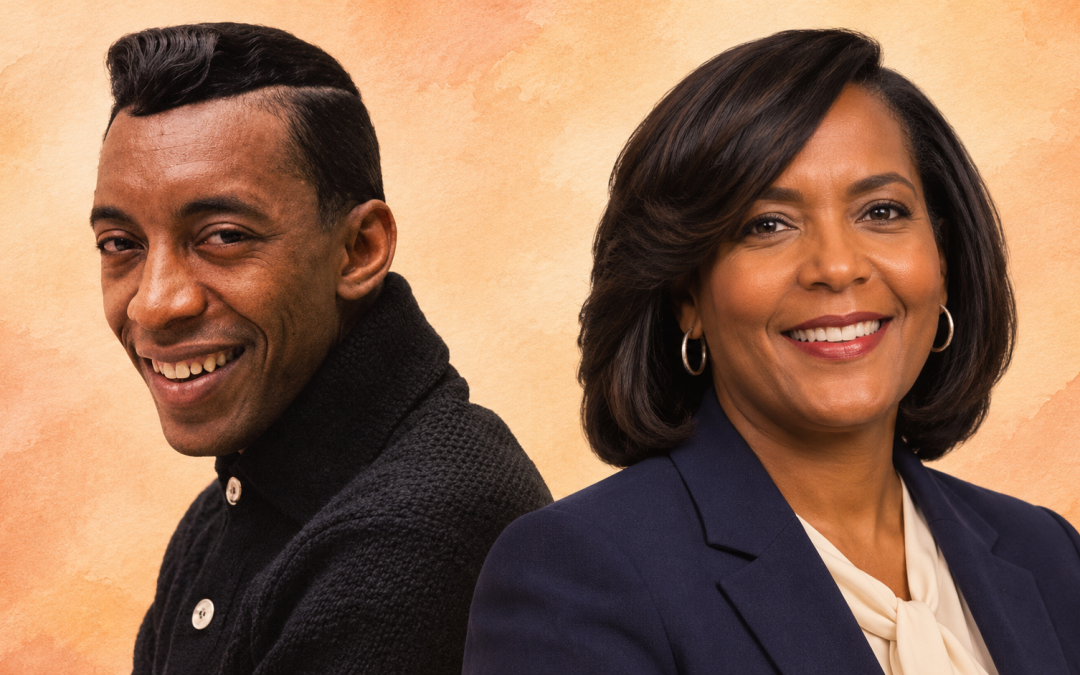
Soul singer Major Lance and his daughter, Keisha Lance Bottoms. AI-generated illustration incorporating a historical photograph of Lance.
Georgia Governor-elect Keisha Lance Bottoms got my attention when she quoted Gladys Knight’s megahit, “If I Were Your Woman,” during her acceptance speech, and it struck a chord. The more I listen to her, the more impressed I am with h er presence and attitude. I soon discovered she is the daughter of Major Lance, a name I had not heard in a while, but one I certainly remembered from the countless times I hummed along to his hit song, “Um, Um, Um, Um, Um, Um.”
Major Lance had his moments of fame, including a Grammy nomination and opening for the Beatles, and he had his struggles with substance abuse. The governor-elect describes him this way in a 2020 Glamour profile by Tayari Jones: “My father wasn’t a perfect man, but he loved me in this perfect way.”
“My dad always believed in the best in me,” she says. “He was the one who always made me think that everything was possible. And he would say, ‘Did you try, did you ask? All they can do is tell you no.’ And he taught me that it was okay to fail. But the real failure is if you didn’t try.” She is one of the rising stars of the Democratic Party, and her governing in Georgia and the Democrats in Congress will determine whether this version of the Democratic Party can begin the healing needed to bring Americans together.
Her story resonates with me because the issue of Black fatherhood motivated me to return to school and complete my education after decades of waiting for the right time. Back in the 1990s, right about the time when Black men were being discussed as an “endangered species,” I landed at the Saint Paul Community Baptist Church in Brooklyn’s East New York neighborhood, which had gained notoriety when local police dubbed it “the killing fields.” The pastor deliberately reached out to Black men, many of whom were struggling to find their place in society. I was one.
Too much of the policy discussion reduced the struggles of Black men to absent fathers. Family relationships mattered, but that explanation gave insufficient attention to underfunded schools, discrimination, aggressive policing, and limited employment opportunities. The consensus was that they lacked the moral fortitude that came with growing up in intact families. President Barack Obama was separated from his father early in life and could relate to growing up with a single mom. He occasionally challenged fathers to be more responsible.
My father died when I was 16 years old. He lived long enough to set me on a path to succeed, but he was absent at the most critical time in my development. I knew their pain. I know how important it is to have a father present in your life. I channeled my trauma into a connection with Ron Mincy, a major figure in the national fatherhood movement, and co-authored a chapter with him in the edited Urban Institute book Black Males Left Behind.
What does this have to do with the challenge facing Democrats? Public policy too often begins with assumptions about people rather than an understanding of their lives. Bottoms’s story reminds us how much those assumptions can miss. Democrats must listen closely enough to understand the people whose confidence they hope to earn.
Young American men across racial and ethnic groups are a significant voting bloc, as are young voters generally. However, young men face serious difficulties establishing stable, independent lives. According to the Pew Charitable Trust, young women outpace them in college completion. In 1995, young men and women were equally likely to hold bachelor’s degrees (25% each). Today, 47 percent of U.S. women ages 25 to 34 have a bachelor’s degree, compared with 37 percent of men. Young Black men and women have lower completion rates.
The challenge for Democrats is understanding the needs of a diverse coalition of voters who soundly rejected Donald Trump’s policies and are giving them a chance to put the nation on a more egalitarian footing. It cannot be business as usual, which means much less time raising money and more time raising hopes.
Troubling signs are already emerging as Democrats vie for caucus leadership in the House and Senate. Hakeem Jeffries is the heir-apparent to the Speaker’s gavel when the new Congress convenes in January, and Chuck Schumer believes he has earned the right to lead the Senate as Majority Leader. Yet incoming members of Congress—and many in the public—are unhappy with their reliance on corporate financing, especially from AIPAC.
Democrats should focus on holding public town halls, inviting people who disagree, and building an agenda around the pressures families face, including healthcare and childcare costs. Explain what Congress can accomplish and where presidential opposition will limit it. Winning an election creates an opportunity. Earning lasting confidence requires showing people that their concerns shape how government works.