
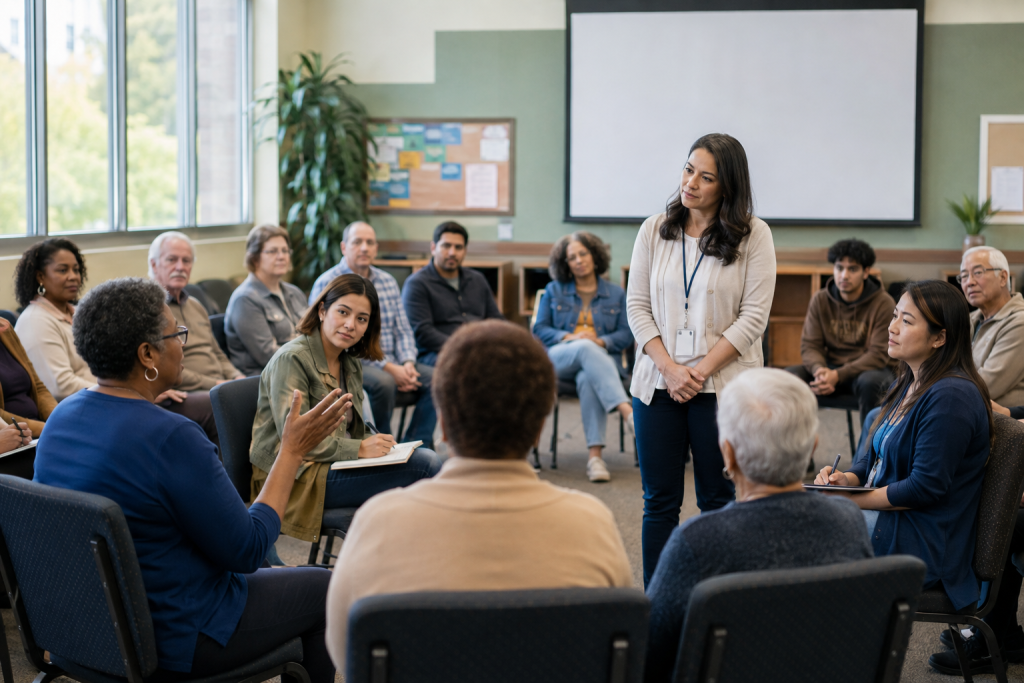
Social worker facilitating a neighborhood issues forum.
Community organizing has been a mainstay of social work since its inception more than a century ago. It remains a significant focus of where we put our resources to work. In some ways, it is so ingrained in our DNA that we take it for granted. Perhaps it’s time we re-examine how we work with communities to ensure we provide the most appropriate service as technology and society evolve, particularly in the age of artificial intelligence and misinformation. What is our role in empowering communities and their residents?
Lately, we at CRISP have adopted the idea of taking communities to Congress to describe our advocacy work on the Hill. It is what social workers do. We carry the needs and concerns of various communities to Congressmembers and their staff, in the legislative proposals and briefings we conduct, in our meetings with other advocates, and in virtually everything we do in Congress and other legislative settings. And we work to empower communities to be their best advocates by including those with lived experience in these settings. So, empowering communities is not a novel concept; we just need to ensure we use the most effective means to raise their understanding of the issues.
The midterm elections will be a particularly important and challenging time for communities, as each will be affected by different policies and face difficult decisions about vaccines, healthcare, housing, and food assistance. There are many uncertainties about voting in November as the Trump administration ramps up its effort to limit who gets to vote and how. Although the Department of Homeland Security vehemently denies ICE agents will be illegally stationed at polling places, just talking about encountering agents with gloves that deliver electric shocks is enough to discourage some voters from going to the polls. Couple that with efforts to limit voting by mail, and you understand the need to help people wade through the misinformation.
As important, social workers must decide what roles, if any, we can play as watchdogs regarding the benefits and perils of artificial intelligence. Will we serve as interpreters, explaining in plain language what generative AI can and cannot do? The difference between using AI as an assistant and treating it as an authority. Teaching privacy and data protection to deter AI-enabled fraud. These discussions are ongoing, and perhaps the Social Work Leadership Roundtable might recommend some workable ideas.
Our person-in-environment perspective and the NASW Code of Ethics have made the wellbeing of individuals, families, and communities the core of what we do. Our history of working with communities has been well documented. Scholars like Robert Fisher, Michael Reisch, Iris Carlton-LaNey, Terry Mizrahi, Jack Rothman, and Wilma Peebles-Wilkins, to name a few, have made this their primary work. Michael Sherraden reminds me often that it’s important to acknowledge and appreciate what social workers have been doing for decades as we discuss contemporary policy engagement.
The University of Minnesota Social Welfare History Archives, founded by Clarke Chambers in 1964; the Virginia Commonwealth University (VCU) Libraries’ Social Welfare History Project; the Association for Community Organization and Social Action (ACOSA); the Journal of Community Practice; and the NASW Foundation’s Social Work Pioneers program are noteworthy repositories of social work’s history.
During my years at Howard University School of Social Work, I organized several town hall-style events and invited community members and policymakers to gather for discussions and question-and-answer sessions on topics such as mental health and criminal justice. One event included the Director of the DC Department of Mental Health, Steve Baron, who is a graduate of Howard University School of Social Work. Howard University continues to provide these forums, the latest of which was a discussion of housing and gentrification in Washington, DC.
My guess is that events like these are being held by many social work schools and organizations, both in-person and virtually. Let me know if your school or organization is engaged in these types of activities.
Advocacy on behalf of individuals and communities has been and continues to be foundational for the profession of social work. Society has changed immensely since the time of Jane Addams, Mary Richmond, Frances Perkins, Harry Hopkins, George Edmund Haynes, Forrester B. Washington, Whitney M. Young, Jr., Ron Dellums, Dorothy I. Height, and the many others who worked to improve it. Latino social workers such as Antonia Pantoja, Carmen Rivera de Alvarado, and Alejandro Garcia are often unrecognized for their contributions.
In my forthcoming book, The Art of Strategic Advocacy: Finding the Balance between Passion and Reason, I address the need to re-examine our approach to advocacy in the 21st century, beginning with the need to be laser-focused on what it is we want to accomplish. Social workers must lead the effort to make this society more egalitarian. We must be prepared and committed to the work.